


Table of Contents
Introduction
Beans farming in Kenya is one of the most rewarding ventures for both smallholder and commercial farmers, thanks to high market demand and relatively low production costs. It involves selecting the right variety for your region, preparing fertile land, planting at correct spacing, and managing pests and diseases to ensure a high yield. With proper planning, one acre can produce between 8–15 bags of clean, market‑ready beans per season.
This guide explains how to plant beans in Kenya step‑by‑step, from variety selection to harvest, using proven practices recommended by agricultural research and extension officers.
1. Why Beans Farming in Kenya is Profitable
Beans are the second most important food legume in Kenya after maize, consumed daily in nearly all households. They’re not only a staple food but also a cash crop, with steady demand across rural and urban markets.
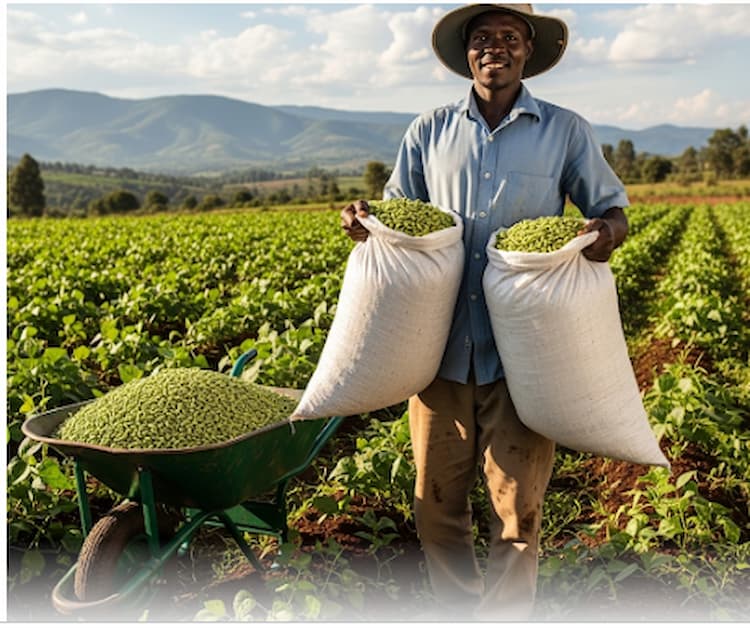
Key profitability factors:
- High demand throughout the year – Beans are a dietary staple, meaning sales are consistent regardless of the season.
- Short maturity period – Many varieties mature in 60–90 days, enabling up to two harvests annually in some regions.
- Multiple market channels – Farmers can sell to open-air markets, schools, hotels, millers, and exporters.
- Soil improvement benefits – Being legumes, beans fix nitrogen into the soil, reducing fertilizer costs for subsequent crops.
Under good management, bean production in Kenya can achieve yields of 8–12 bags per acre, with well‑managed commercial farms achieving 15+ bags per acre. At an average farm‑gate price of KSh 6,000 per 90‑kg bag, a farmer can make KSh 42,000–72,000 profit per acre per season.
📌If you’re exploring other profitable ventures, here’s our full list of small-scale agribusiness ideas in Kenya worth considering.
2. Choosing the Right Variety
The choice of variety determines your yield, market price, and resistance to pests and diseases. Always select certified beans seeds in Kenya from trusted suppliers such as Kenya Seed Company, Simlaw Seeds, or registered agro‑dealers to guarantee germination and disease‑free planting material.
Popular beans variety in Kenya and their characteristics:
- Rosecoco – High yielding, excellent taste, very marketable in urban areas.
- Yellow beans – Premium market price, long shelf life.
- Nyayo beans – Drought‑tolerant, good for marginal areas.
- Mwitemania – Popular in Kenyan households for taste and cooking quality.
- Mwezi Moja beans in Kenya – Extremely early maturing (about one month); ideal for quick turnover, but lower yield than long‑maturing types.
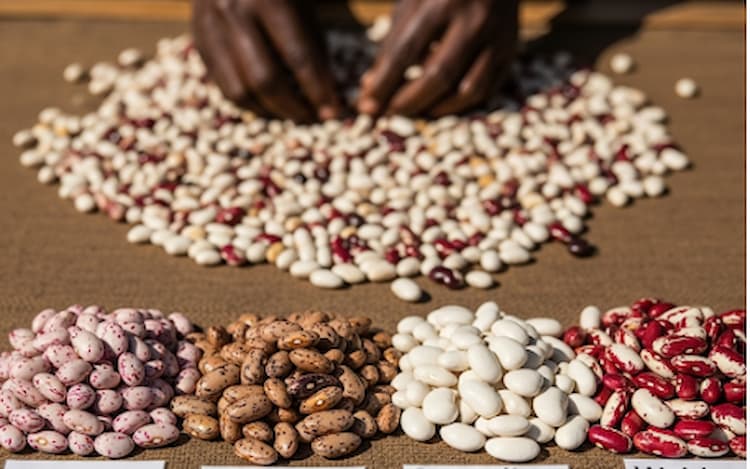
💡 Tip: Match the variety to your altitude, rainfall pattern, and market demand. For example:
- High altitude (cool) → Nyayo, Rosecoco.
- Mid altitude → Yellow beans, Mwitemania.
- Low rainfall → Mwezi Moja, Nyayo.
3. Land Preparation
Beans thrive in well‑drained soils with a pH of 6.0–7.0. Avoid waterlogged fields, as excess moisture encourages root rot.
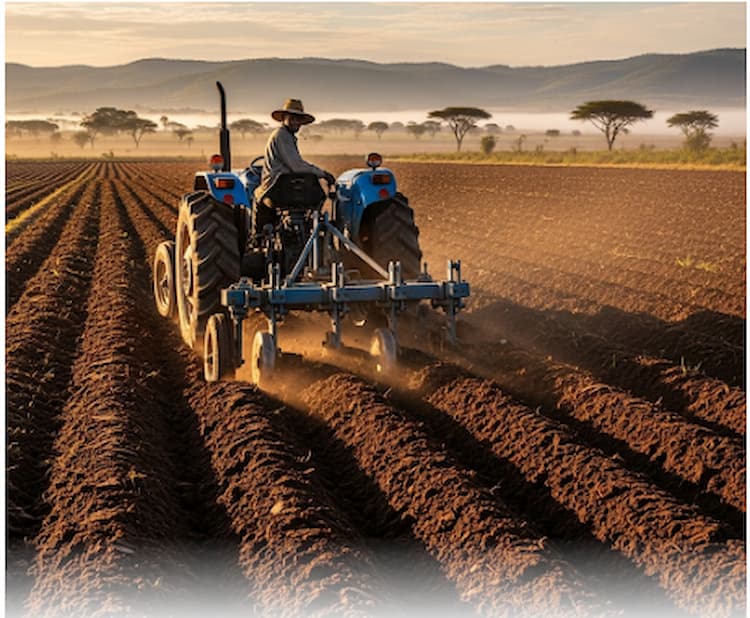
Best practices for land preparation:
- First ploughing: 2–3 weeks before planting to expose weeds and soil‑borne pests.
- Harrowing: Break soil clods to achieve a fine tilth for better seed‑to‑soil contact.
- Weed control: Remove perennial weeds like couch grass before planting.
- Soil testing: Helps determine if liming is needed to correct soil acidity.
💡Tip: Beans are sensitive to compaction. Avoid heavy machinery on wet soil to prevent hardpan formation, which limits root growth and water infiltration.
4. Planting Guidelines
The planting stage is where many farmers lose yield potential due to poor spacing and wrong seed rates.
Best Planting Seasons
- Long rains: Mid‑March to early May.
- Short rains: Early July to early August.
- Under irrigation, beans can be planted year‑round.
Spacing for Optimal Yield
Correct spacing prevents overcrowding and reduces competition for nutrients, sunlight, and water.
Recommended beans spacing in Kenya:
- Row spacing: 45 cm (18 inches) between rows.
- Plant spacing within rows: 10–15 cm (4–6 inches) between plants.
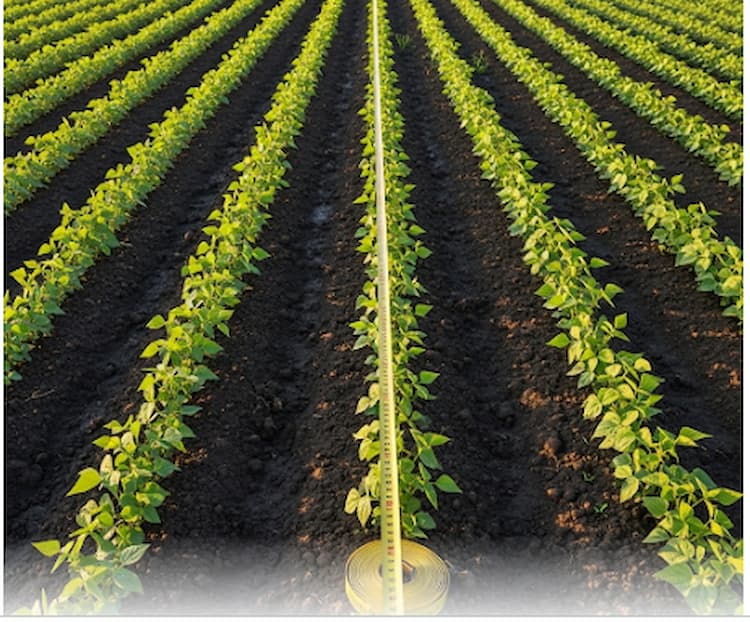
Image showing spacing of beans in Kenya.
Seed Rate
For most varieties:
- 35–40 kg of certified seed per acre is required.
This answers common queries like: - How many kgs of beans to plant per acre? → 35–40 kg.
- How many kilos of beans can be planted per acre? → Same as above.
- How many kilograms of beans per acre? → 35–40 kg.
Depth of Planting
- Plant seeds 3–5 cm deep.
- In sandy soils, plant slightly deeper to access moisture.
💡 Extension Tip: Always treat seeds with an appropriate fungicide/insecticide before planting to reduce early pest and disease attack.
READ ALSO: How to practice hydroponic farming in Kenya
5. Crop Management
Weed Control
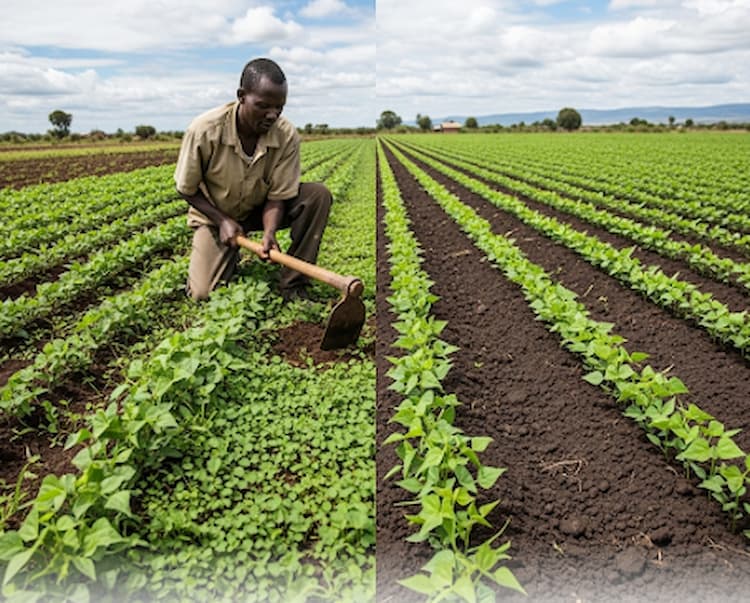
With beans farming in Kenya, timely and effective weed management is essential for healthy crop growth and maximum yields. Weeds compete with beans for water, nutrients, and sunlight—especially during the first six weeks after germination when the crop is still establishing.
Recommended weed management schedule:
- First weeding – 2–3 weeks after germination, before the bean canopy closes. This early intervention reduces competition during the most critical growth stage.
- Second weeding – Just before flowering, to stop weeds from competing for resources during the reproductive phase.
Additional tips:
- Always weed carefully to avoid damaging the shallow root system of beans.
- For large‑scale beans farming in Kenya, consider using pre‑emergence or post‑emergence herbicides as recommended by agricultural extension officers to save time and reduce labour costs.
- Remove persistent perennial weeds like couch grass completely, as they can regrow quickly.
Proper weed control not only boosts yields but also helps reduce pest pressure by eliminating hiding spots for insects such as cutworms and bean flies.
Fertilizer and Manure Application
Beans are legumes, so they fix their own nitrogen from the atmosphere through root nodules. Over‑applying nitrogen fertilizers can reduce pod formation.
- At planting: Apply DAP at 100 kg per acre or well‑decomposed farmyard manure at 8–10 tonnes per acre.
- Top dressing: If plants show yellowing (nitrogen deficiency), apply a light dose of CAN or urea about 3–4 weeks after germination.
💡 Tip: Incorporating manure improves soil structure, moisture retention, and microbial activity — essential for sustainable beans farming in Kenya.
Pest & Disease Control (Beans Farming in Kenya)
Protecting your crop from pests and diseases is critical for high yields in beans farming in Kenya. Below are the main threats, their signs & symptoms, and recommended controls based on practical, farm‑tested methods used by Kenyan extension services.
1. Cutworms & Bean Fly (Ophiomyia phaseoli)
Signs & Symptoms:
- Cutworms: Young plants cut at the base, often found lying on the ground; damage usually occurs at night.
- Bean fly: Seedlings appear stunted and wilt easily; stems may swell or crack at the base. When split, tiny white maggots may be visible inside the stem.
Controls:
- Seed dressing: Treat seed with SHIELD 600FS at 3 ml/kg before planting.
- Soil drench: Apply PROFILE 440EC at 3 ml/L in planting furrows immediately after sowing.
- Foliar spray: Use LEXUS 247SC at 8 ml/20 L if adult flies are seen or damage is present.

2. Red Spider Mites, Aphids, Whiteflies
Signs & Symptoms:
- Spider mites: Fine webbing under leaves; leaves turn yellow, curl, and drop prematurely.
- Aphids: Clusters of small green, black, or brown insects on young shoots; curled leaves and sticky honeydew present.
- Whiteflies: Tiny white insects fly up when leaves are disturbed; underside of leaves coated with sticky honeydew leading to sooty mould.
Controls:
- Spider mites: Spray ALONZE 50EC at 5 ml/20 L.
- Aphids: LEXUS 247SC at 8 ml/20 L, or JAMBO CLEAN at 5 ml/L if sooty mould appears.
- Whiteflies: PROFILE 440EC at 1.5 ml/20 L plus JAMBO CLEAN to clean leaf surfaces.
3. Thrips & Pod Borers
Signs & Symptoms:
- Thrips: Silvery streaks or blotches on leaves; flower buds fail to open or drop early.
- Pod borers: Chewed holes in pods; frass (insect waste) inside pods; beans inside are damaged or missing.
Controls:
- Thrips: Spray ALONZE 50EC at 5 ml/20 L or PROFILE 440EC at 30 ml/20 L during early flowering.
- Pod borers: Use PENTAGON 50EC at 10 ml/20 L when pods start forming.
4. Fungal Diseases – Rust, Downy Mildew, Anthracnose
Signs & Symptoms:
- Rust: Small orange‑brown pustules on both sides of leaves; leaves may dry and fall prematurely.
- Downy mildew: Yellow patches on upper leaf surfaces; white fluffy growth under leaves, especially in cool, humid weather.
- Anthracnose: Dark, sunken spots on pods, stems, and leaves; infected pods may shrivel.
Controls:
- Rust: DUCASSE 250EW at 1 ml/L or RANSOM 600WP at 15 g/20 L.
- Downy mildew: GEARLOCK TURBO 250WP at 25 g/20 L.
- Anthracnose: RANSOM 600WP (15 g/20 L) or ABSOLUTE 375SC at 10 ml/20 L.
5. Bacterial Blight & Fusarium Wilt
Signs & Symptoms:
- Bacterial blight: Water‑soaked spots on leaves that turn brown and irregular; severe cases lead to leaf drop.
- Fusarium wilt: Plants yellow from the bottom up, wilt even when soil is moist; brown discoloration visible inside cut stems.
Controls:
- Blight: Spray GREENCOP 500WP at 50 g/20 L.
- Fusarium wilt: Drench soil around seedlings with GREENCOP 500WP (5 g/L) or TRINITY GOLD 425WP at 2.5 g/L.
6. Angular Leaf Spot (Phaeoisariopsis griseola)
Signs & Symptoms:
- Small angular brown spots on leaves, often bordered by veins.
- Spots enlarge and merge, causing large dead patches; severe infection leads to premature leaf drop.
- In wet weather, fungal growth may appear on the underside of leaves.
Integrated Controls:
- Plant resistant varieties such as Rosecoco or Nyayo.
- Use only certified, disease‑free seed.
- Remove volunteer plants and bean residues after harvest.
- Rotate beans with non‑legume crops for at least one season.
- If needed: spray RANSOM 600WP (15 g/20 L), ABSOLUTE 375SC (15 ml/20 L), TRINITY GOLD (50 g/20 L), CHARIOT 500SC (20 ml/20 L), or EXEMPO CURVE 250SC (15 ml/20 L).
- Alternate products to prevent resistance; add INTEGRA (3 ml/20 L) to improve spread and sticking.
Irrigation
In rain‑fed farming, water stress during flowering can drastically reduce yields. In irrigated systems:
- Apply water during germination, flowering, and pod filling stages.
- Avoid over‑watering as beans are prone to root rot.
6. Harvesting and Yield
When to Harvest
- Dry bean pods turn yellow‑brown and rattle when shaken.
- Harvest promptly to avoid shattering losses, especially for varieties like Mwezi Moja beans in Kenya which mature quickly.
Expected Yields
Under average smallholder conditions:
- 8–12 bags (90 kg each) per acre.
Under good management:
- 15+ bags per acre for improved varieties and well‑fertilized soils.
This directly answers:
- How many bags of beans per acre in Kenya? → 8–15 bags.
Post‑Harvest Handling
- Dry beans to 12–13% moisture content to prevent mould growth.
- Use raised drying racks or mats to avoid contamination.
- Store in airtight bags with pest‑control treatments (e.g., Actellic Super dust) to prevent weevil damage.
💡 Tip: Poor drying and storage are the main causes of post‑harvest losses in beans farming in Kenya. Always dry to safe moisture before storage.
7. Costs and Profitability Analysis
| Item | Cost (KES) |
|---|---|
| Land preparation | 5,000 |
| Certified seeds | 4,000 |
| Fertilizer/manure | 5,000 |
| Labour (planting, weeding, harvesting) | 6,000 |
| Pest & disease control | 2,000 |
| Total Cost | 22,000 |
Income potential:
- Selling price: ~KSh 6,000 per 90‑kg bag.
- Average yield: 10 bags → KSh 60,000.
- Net profit: ~KSh 38,000 per acre per season.
💡 Tip: Planting high‑demand varieties like Rosecoco or Yellow beans can push your net profit even higher.
8. Common Challenges and Solutions
| Challenge | Solution |
|---|---|
| Erratic rainfall | Plant early with rains; use drought‑tolerant varieties like Nyayo and Mwezi Moja. |
| Pests and diseases | Rotate crops; use resistant varieties; timely spraying. |
| Low market prices | Store until peak demand; explore institutional or export contracts. |
| Poor soils | Apply organic manure; lime acidic soils. |
9. Conclusion and Next Steps
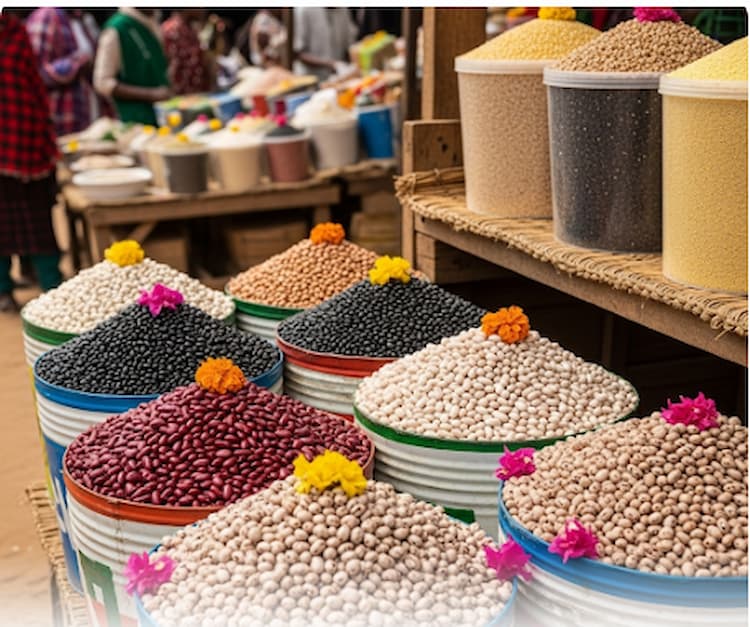
Beans farming in Kenya remains one of the most profitable and reliable crops for both food and income. By choosing the right variety, following proper spacing, using quality certified seeds, and applying good crop management, farmers can achieve high yields and strong market prices.
10. FAQs – Beans Farming in Kenya
How many kgs of beans to plant per acre in Kenya?
Most varieties require 35–40 kg per acre.
What is the spacing for beans in Kenya?
Rows: 45 cm apart, plants: 10–15 cm apart.
Which are the high‑yielding beans varieties in Kenya?
Rosecoco, Yellow beans, Nyayo beans, Mwitemania.
How many bags of beans per acre in Kenya?
Average: 8–12 bags, well‑managed: 15+ bags.
Can I intercrop beans with maize?
Yes. Maintain wider maize spacing to allow sunlight for beans.
Where can I get certified beans seeds in Kenya?
From registered agro‑dealers, Kenya Seed Company, or Simlaw Seeds.
📌 Looking to expand beyond beans? Discover where to get quality tree seedlings for sale in Kenya for your next farming project.


Leave a Reply